Ironically, a book that doesn’t condemn immortality or those seeking it is a rare find in mortal worlds. I’ve always been perplexed by mortals’ acceptance of aging and death while they fight against both with science and/or magic. Even if I weren’t a pagewalker, I don’t think I’d get bored for an awfully long, long time with so much to do, see, and learn on a single planet.
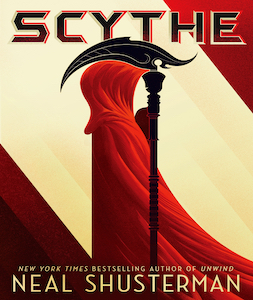
To be clear, I wouldn’t want true immortality, the kind that prevents you from dying at all. Biological immortality is far more reasonable, and there are pagewalkers who have achieved it through graduation. Nonetheless, an ethics class is required, and for my ethics class, we were assigned Scythe. In this world, scarcity, disease, and natural death have been eradicated, yet people still have to die.
“Scythes” are the human orchestrators of death, and they choose their victims based on age, race, gender, lifestyle, etc. And they’re allowed to kill you in a variety of ways. For some truly bizarre reason, everyone had agreed that this particular annual population cull was in the best interests of a post-mortal humanity. Considering the mysterious disasters of the moon and Mars colonies that would’ve allowed the species to expand, what other choice was there?
Well, to begin, I had an idea soon after arriving: deactivate the nanites for those who choose to have biological children. An immortal life for an immortal life. At least until the numbers dropped by allowing people to request their own gleanings when they’d had enough life. Really, why hadn’t this been considered? It was such a no-brainer that I had to bend the rules of pagewalking and ask around.
I was not expecting to be met with outrage, as if I had suggested that children should die to spare adults. I was called selfish, among more colorful names, and told that a scythe should “glean” me. There just so happened to be one in our vicinity, and people quickly made way for him as the commotion drew his attention. He treated my question as though it were naive and short-sighted, but he wouldn’t give me a solid, unbiased rebuttal. No one would.
The scythe trained me alongside the two teenaged protagonists, Citra and Rowan. I was still yearning for a real answer that could possibly be found in the Scythedom, but I didn’t make it obvious. I was repulsed by the thought of having to take random lives, the first requirement of a scythe—a conscience, compassion.
But how compassionate could a scythe be when they must learn “killcraft,” specializing in weapons and poisons and martial arts, instead of simply administering a pill that induces a quick, painless death?
It was all too mind-boggling for words. Ever since post-mortality, people had lost the incentive to do anything beyond playing generic video games, watching cat holograms, idolizing scythes, and making too many babies. There was supposedly nothing left to learn. The all-encompassing AI, known as the Thunderhead, possessed “infinite” knowledge and had fixed just about everything wrong with the world. I wondered why kids still had to attend school. It seemed like a waste of time when they could simply learn anything they wanted to at home, especially with bot assistance.
For “fun,” some people would occasionally “splat,” which is slang for jumping off a building to make a messy fool of yourself. Since there were revival centers that could put adrenaline junkies back together, splatting entailed no real consequences. Strangely enough, nobody was deeply affected by the gory sights, as if this entire world were just one big video game.
In all my time of visiting written worlds, the thought of plunging to my temporary death for fun had never once crossed my mind. And that was when I realized: what exactly was going on in the brains of these people? What could’ve possibly been making them act like NPC caricatures?
I had a theory: the nanites. They released opiates whenever the nervous system registered the slightest twinge of discomfort. No wonder everyone seemed as high as the sky, I thought. They actually were!
But that didn’t explain why everyone had agreed upon an organization of murderers to maintain the population. Citra and Rowan were as clueless as the rest of them, focused on becoming the better scythe, not questioning the system that nobody had seemingly ever bothered to question.
For my own safety and sanity, I conducted research with the Thunderhead in secret. Since it didn’t interact with the Scythedom as per the law, I had no issues sneaking into its backbrain that few cared to explore. I managed to map out the design of its complex algorithms to yield the information I’d sought.
Except there was no information. Rather, the answer was right in front of me: the Thunderhead had been the one to usher humanity into the age of immortality and post-scarcity. A nonhuman, yet human-created intelligence that had calculated the human majority’s most cherished value: the family, specifically the nuclear kind.
In almost every written world I visit, mortals in general value family and legacy more than anything, and they are willing to die to protect their blood. They want so strongly to live on through their descendants. Why would the Thunderhead seek to change that?
I imagine there used to be people who shared my thoughts in the world of Scythe. People who lived modest lives, even when they had every reason to go full hedonist. People who didn’t burden the planet with twenty mouths to feed, even in post-scarcity. And they were gleaned.
I saw what Rowan was becoming under the apprenticeship of his new scythe. I thought he was going down a dark road, but he proved otherwise. Then again, the Scythedom would still consider it dark had they known his secret. The scythes were more at risk than the people. He almost inspired me to follow in his steps, only to diverge onto the path that would lead me to dismantling the entire system. I would then rebuild a superior one from the ground up with the biologically childfree in mind. The Thunderhead did not spy on scythes nor involve itself in our matters, after all.
Of course, I held back. Pagewalking rules aside, making such a revolution happen would be a near-impossible task. Humanity and the Scythedom were both a lost cause. Who would join me? Nobody was unique in mind or body anymore. Humans had assimilated into one big amorphous blob, content to do nothing more than pass time and genes.
What makes this book a dystopia or a cautionary tale is not the eradication of suffering, disease, or death; it’s protecting and valuing the nuclear family above all. It’s consumerism with babies. It’s treating human beings like disposable commodities. It’s relying on an AI to solve all of the world’s problems instead of listening to minority voices.
And that is a dystopian world we should all try to avoid.
 Pagewalking